Saturday, 30 July 2011

Plight of the Algerian residents

The plight of Algerian residents on strike has sparked interest in the United States.


We received the following request from Jack dePaolo to put him in contact with residents willing to share their experiences.

Hi, my name is Jack dePaolo, I am an MD / PhD student in the United States, at Louisiana State University in New Orleans. I am also affiliated with Medscape http://www.medscape.com/medicalstudents I am currently working on a story about Algerian medical trainees and their fight for higher wages and the end to the public service requirement. I was wondering whether you could put me in touch with any medical residents in Algeria.


Please also feel free to share your feelings and experiences here with the group, thanks.


If anyone wishes to contact Jack, his email is jack.depaolo@gmail.com


Medical English classes

It is with great excitement that I bring you news of Medical English classes at Hopeland Institute.


Whilst demand for these classes has waned over the past few years, new interest is being shown by Algerian doctors and vets keen to learn English designed to help them understand medical terminology.


It is hoped that new classes will start in Cheraga in September and those hoping to benefit are advised to register their interest as soon as possible so they can be added to the waiting list.


To find out more about previous courses, please see previous posts and comments from our students.

A test of level will be required prior to registration to ensure an adequate base in English. You will need level 3 to take these classes.


Please contact Hopeland Institute directly for more information or to book a test of level.

We really hope you enjoy studying with us!!

Saturday, 9 April 2011

50 / Fifty Magazine in English


This is an Algerian magazine written in English. It is about Algeria and other parts of the world. The aim of this magazine is to help Algerians in learning English and inform the world about different aspects of Algeria.


There will, insha'Allah be 2 medically related pages, one for the general public and one for doctors.


If you would like to write anything for the magazine, please email me.

We are also looking for Algerian doctors and medical students to interview living both in Algeria and other parts of the world.

If you have any ideas for these pages, please let me know :-)


If you are interested in other aspects of the magazine then please visit Hopeland Institute Algiers Facebook page

Working as a doctor abroad


I received a message in my Facebook inbox about Meda Doc advertising jobs for Algerian medics abroad. Not sure if it's of use to anyone?

Medical Emigration?


Last week in my outpatient clinic, I met a lady who told me that she misses her homeland, she misses the weather, her family and the lifestyle. I asked her what was stopping her returning and was shocked when she told me it was the health service. She had had previous surgery in the UK and was concerned that if she ever left and the problem returned, she would not be able to afford the care required.


I found this very sad. Would you ever consider sacrificing everything for the sake of good healthcare, even if it meant living apart from your family?

Monday, 22 February 2010

Clinical Research


Are you involved in Clinical Research in Algeria?
Are you able to get your work published nationally or Internationally?
How do you get access to International research?
I'm really interested to hear your experiences.


Monday, 4 January 2010

H1 N1 Influenza Virus


As of the 1st of January 2010, there have been 47 deaths and 746 cases of H1N1 virus in Algeria. In the UK there have been 303 deaths. As a healthcare professional I had the vaccine last week in London to protect my patients. Apart from a heavy arm, I had no other side effects, although I heard that a doctor in Setif died 9 hours after having the injection?
What is the current mood in your country about Swine Flu amongst medical professionals and the general public in your country, I would love to hear your views and experiences?


Friday, 1 January 2010

50:50 Magazine


The staff at Hopeland Institute are in the process of collating articles to produce a magazine in English for Algerians. It is proposed that there will be a medical article in each issue and therefore I am asking for your help.

If you are interested in contributing to this venture, we are looking for medically focused articles in English which can be submitted to me directly at mahdiyyahbensaid@hotmail.co.uk

Here are some ideas:
  • My experiences of studying medicine abroad or in Algeria
  • My experience of studying medical English
  • Advances in medicine
  • Short research summaries
  • Your thoughts on an area of healthcare

We are open to any suggestions or ideas you may have and welcome all submissions. I can help with editing if you would like your work edited prior to printing.

I feel this will be a fantastic oportunity to share our knowledge and experience with a wider audience whilst using the English language.

If you have any questions, please ask and I look forward to reading your suggestions / submissions.

Happy New Year 2010

May I take this opportunity to wish you all a New Year full of happiness and prosperity, good health and the motivation to achieve all your goals.

I was thrilled to hear this week that one of our first Medical English students was in London recently studying cardiology and another has been successful in her application to study abroad in her chosen field. May I congratulate them both on their hard work and wish them all the very best for the future. I am impressed by their determination to succeed despite the difficulties they face and may they be an inspiration to all.

So what are my aspirations for the New Year? Well I'd have to say that being back in Algeria would be my ultimate dream so this year I vow to work hard to enable that to happen insha'Allah as soon as possible. In the interim, I hope to continue to make contacts in the UK to help develop the Medical English Programme in Algeria in the future. I will attempt to keep you informed of any events I hear about and will be in cyber space for all your questions and queires.

I will continue to manage the Medical English programme in Algeria and keep the blog and Facebook group updated with any news. Please feel free to contribute where you can to help one another.

Wishing you all a very Happy New Year and All the Best in your work and studies.

Wednesday, 9 December 2009

US Embassy Medical Secretary Vacancy


Vacancy Announcement
U.S. Embassy
Algiers, Algeria
Vacancy Announcement# 51-2009
OPEN TO: All Interested Candidates
POSITION: Medical Secretary, FSN-7*; FP-7**
OPENING DATE: December 8, 2009
CLOSING DATE: Open Until FilledWORK HOURS: Full-time; 40 hours/week
COMPENSATION: DZD 719,899* (Grade 7) *This represents the total annual compensation including salary, bonus and benefits.**Not-Ordinarily Resident (NOR); Salary to be confirmed by Washington.
NOTE: NON-ALGERIAN RESIDENT APPLICANTS MUST BE RESIDING IN COUNTRY AND HAVE THE REQUIRED WORK AND/OR RESIDENCY PERMITS TO BE ELIGIBLE FOR CONSIDERATION

The U.S. Embassy in Algeria is seeking an individual for the position of Medical Secretary in the Health Unit.

BASIC FUNCTION OF POSITION The Medical Secretary performs receptionist/administrative duties in support of the Embassy Health Unit staff. Works under the direct supervision of the Post Medical Officer. Performs Health Unit (HU) receptionist duties: answers phone, connects calls from the Health Unit Medical Officer to appropriate health professionals, directs calls from outside health professionals to the appropriate office in the mission, arranges appointments, and answers inquiries regarding the Health Unit’s services. Takes inventory of HU equipment and supplies, and reviews with the staff of the HU. Serves as receiving staff for the HU for supplies, puts away those supplies that are not “controlled” items and orders office supplies. Translates medical reports and documents in relation with Health Unit, from French to English and English to French languages. Please contact the HR Office if you wish to review a copy of the complete position description listing all duties and responsibilities of the position.

QUALIFICATIONS REQUIRED All applicants must address each selection criterion detailed below with specific and comprehensive information supporting each item.
1. Required Education: Two years of university is required. Nursing or Medical education is desirable
2. Prior Work Experience: Two years of office secretarial experience is required. Knowledge of medical secretary field is desirable
3. Language Proficiency: Level 4 English and French, level 3 Arabic are required
4. Other criteria: Excellent English grammar and spelling. Familiarity with medical terminology. Knowledge of general office procedures and computers is essential.
5. Other Skills and Abilities: Good interpersonal and communication skills; ability to interface with many people, both in person and on the phone. Must be organized, be tactful and understand patient confidentiality. Must be able to translate French medical documents to English.

ADDITIONAL SELECTION CRITERIA 1. Management will consider nepotism/conflict of interest and budgetary restrictions in determining successful candidacy.2. Current employees serving a probationary period are NOT eligible to apply.3. EFMs who currently hold an FMA appointment are ineligible to apply for advertised positions within the first 90 calendar days of that appointment.

SELECTION PROCESS Eligible Family Members and U.S. Veterans will be given preference when considered equally qualified for Embassy Vacancy Announcements. Therefore it is essential that the candidates address the required qualifications as specified in the application.
TO APPLY Interested applicants for this position must submit (1) and (2) below: 1. Preliminary Documentation* Current Resume. A current resume or curriculum vitae that provide the same information as an OF-612.* Letter of Interest. You must attach to the letter:o References: Be ready to provide contact information (i.e. name, address, phone number, email address) for three (3) current and/or previous supervisors.o Indication as to whether you are currently employed with the embassy; and whether you have a relative currently working within the Mission. If so, provide their contact information (i.e. name, address, phone number, email address).2. Proof of education.* Copies of relevant diplomas or degrees (as required) by the position.* Any other documentation that addresses the qualification requirements of the position as listed above. Applicants should make sure to send copies of their documents and not originals as we cannot ensure return of originals.Interested applicants may choose to submit the below application form with the package detailed in (1) and (2). Alternatively they can wait to do so until required in the hiring process. Unsuccessful applicants will not receive an invitation to attend the interview. 3. Employment Application Form.* All prospective employees must complete an Embassy application form (usually the Federal Employment OF-612, available at the HR Office). * Can be submitted if selected for an interview.

ALL APPLICATIONS MUST BE SUBMITTED IN ENGLISH AND THE DOCUMENTS REQUESTED ABOVE MUST BE SUBMITTED OR THE APPLICATION WILL NOT BE CONSIDERED.

CLOSING DATE FOR THIS POSITION: Open Until Filled The US Mission in Algeria provides equal opportunity and fair and equitable treatment in employment to all people without regard to race, color, religion, sex, national origin, age, disability, political affiliation, marital status, or sexual orientation. The Department of State also strives to achieve equal employment opportunity in all personnel operations through continuing diversity enhancement programs.

Point Of Contact: Submit Application to: Human Resources OfficeAttention: Medical Secretary, Vacancy Announcement #51-2009Point of Contact: Human Resources Office
For quickest reception fax to: 021-60-73-35
Post to: BP 408 16000 Alger GareE-mail to: usembassyalgiers_app@state.gov Note: Only the best qualified applicants will be contacted for a test and an interview
Drafted: NBentouraCleared:AKabouhi/ SOulmane/ CBrown
Approved: JMiller

Monday, 12 October 2009

First Winter Multi Disciplinary University in Algiers


The DGRSDT Jointly with ACA and CERIST announce the opening of registration for the winter university to be held at CERIST facilities in Algiers in December 19-29. The courses will be taught by Algerian experts working in renowned international institutions and companies. The goal of the program is to promote the excellence in knowledge transfer and exchange between skilled Algerians living abroad and their peers in Algeria.

Designed for Ph.D. graduates, academics, administrators, researchers, laboratory managers, research directors and corporate trainers who wish to learn strategies and techniques in management and leadership. It also targets health professionals, pharmaceutical and life science professionals and researchers to learn about the latest developments in Biomedical imaging systems, preclinical drug discovery and development and novel medical treatment. It also offers comprehensive training to all researchers at all levels and disciplines in health and safety. Participation is based on a selection criteria and the process as detailed in the registration form.

Certificates Guidelines
In the ten days of the winter university, participants will be taught 25 specialized courses structured under three certificates:
* Project Management and Leadership Certificate
* Heath and Safety certificate
* Biomedical Imaging Certificate
* Preclinical Drug Discovery and Development Certificate
Participants will be able to complete one or more certificates by taking the core courses and at least three elective courses have details in each certificate program. For effective teaching, classes contain no more then 20 students per class for the elective courses.

The Winter University is designed to meet the need and interest of a larger number of applicants. The courses will also be shown by CERIST using video conferencing facilities. Other Universities and those who are not selected to attend physically can follow courses online at any of the designated Universities.

Steps for Enrolling and Earn Your Certificate
1. Choose your certificate within one of our areas of teaching
2. Review your Certificate race Matrix and schedule of offerings
3. Register for your certificate program online by visiting and fill in the Questioner
4. Wait for confirmation if you selected for attending the course at CERIST or online at one of the designated universities.
5. Complete all core and elective courses chosen.

We invite those who want to participate to complete the registration online at DG-RSDT : www.nasr-dz.org , DG-RSDT: www.nasr-dz.org, winter_university@nasr-dz.org
Tel: +213 (0)21 63 6840 , Tel: +213 (0) 21 63 6840

ACA: www.aca-dz.org , ACA: www.aca-dz.org, ledesk@aca-dz.org
Tel: +44(0)7999597167 , Tel: +44 (0) 7999597167

Sunday, 6 September 2009

Scottish Medical Pioneers


Edinburgh is very proud of its great tradition of medical pioneers so I thought I’d just outline one or two here to highlight the importance of Scotland in Medical History.
Photos from left to right, top to bottom: Littlejohn, Fleming, Wilmut, Simpson and Lister.

Sir James Young Simpson (7 June 1811 – 6 May 1870) was a Scottish doctor and an important figure in the history of medicine. Simpson discovered the anaesthetic properties of chloroform whilst trying out his latest chemical experiment on his male dinner guests.
It was not initially adopted until Queen Victoria chose to use it during childbirth, after which it became very popular successfully and was introduced for general medical use. When he died, 100,000 people lined the streets and 1000 doctors and nurses walked in the cortege.

Joseph Lister, 1st Baron Lister, OM, FRS (5 April 1827 – 10 February 1912) was an English surgeon who promoted the idea of sterile surgery while working at the Glasgow Royal Infirmary. He successfully introduced carbolic acid (phenol) to sterilize surgical instruments and to clean wounds, which led to reduced post-operative infections and made surgery safer for patients.
Sir Henry Duncan Littlejohn, 1826 - 1914. President of the Royal College of Surgeons, Edinburgh.
As Edinburgh's first Medical Officer of Health, Henry Littlejohn did much to educate the city's population in matters of personal and public hygiene. During his term, the death rate dropped dramatically and cases of smallpox and typhus became a rarity. A Professor of Medical Jurisprudence at Edinburgh University, he was also a brilliant teacher, holding his classes of over 250 students spell-bound.

Dr Andrew Duncan, Medical reformer. Born in
St. Andrews, Duncan attended the University in that town, before going to the University of Edinburgh to complete his education. He followed a medical career, going on to become Professor of the Theory of Medicine at Edinburgh (1790) and President of the Royal College of Physicians. Duncan lectured on public health and set up a dispensary in Edinburgh in 1776 to try to improve the health of its citizens.
Duncan is best known for his humane treatment of the mentally ill. He had been disgusted by the death of his patient the poet
Robert Fergusson (1750 - 74) in the horrific conditions of the Bedlam. He fought for an appropriate institution to house the insane and approval to build the Edinburgh Lunatic Asylum (or East House) was eventually given in 1807. The Asylum was built in the Morningside district of the city by architect Robert Reid and grew into the Royal Edinburgh Hospital.

Sir Alexander Fleming (6 August 1881 – 11 March 1955) was a
Scottish biologist and pharmacologist. Fleming published many articles on bacteriology, immunology and chemotherapy. His best-known achievements are the discovery of the enzyme lysozyme in 1923 and the antibiotic substance penicillin from the fungus Penicillium notatum in 1928, for which he shared the Nobel Prize in Physiology or Medicine in 1945 with Howard Walter Florey and Ernst Boris Chain.

Sir Ian Wilmut,
OBE (born 7 July 1944) is an English embryologist and is currently one of the leaders of the Queen's Medical Research Institute at the University of Edinburgh. He is best known as the leader of the research group that in 1996 first cloned a mammal from an adult somatic cell, a Finnish Dorset lamb named Dolly. He was granted an OBE in 1999 for services to embryo development. In December 2007 it was announced that he would be knighted in the 2008 New Year Honours


The Body Snatchers


During the time on the 'Teaching English for Medicine' course, the story of Burke and Hare in 1827 was recounted numerous times.
In order to run a successful School of Medicine, one requires 3 things:
  • A student body
  • Teaching bodies and
  • Dead bodies (or cadavers)
However, due to mainly religious reasons, it was against the law to use a human body for resection. This led to 'gravediggers' or 'resurrectionists', individuals who would steal bodies from graveyards to supply the local medical schools on the black market. Towers built in cemeteries(like the one in the middle photo) housed sentinels to protect the graves.
However, the price paid for a body depended on it's freshness causing 2 Irish immigrants to hatch a plan to get rich quick!! They would search out lonely individuals, get them drunk, lure them back to their lodging house and then suffocate them before selling them to an ambitious Edinburgh anatomist named Dr Robert Knox. They killed 17 people over the course of a year before being discovered.
Because the evidence against the pair was not overwhelming, the police offered Hare immunity against prosecution if he testified against Burke whicih he duly did. Burke was found guilty and hanged to death in January 1829, after which his body was publically dissected at the Edinburgh School of Medicine. 42,000 people filed past to see the murderer's body. His skin was used to make wallets and book covers and examples of these and his skeleton can still be seen in the Royal College of Surgeons Museum.
In 1832, the laws which led to this case were abolished and people now bequeth their bodies!!
For more information, please click on the title 'The Body Snatchers' at the top of this page which will take you to Wikipaedia.


Edinburgh, City of Medicine


'Scottish Royal College of Surgeons - Surgeons Hall'


During the ‘Teaching English for Medicine’ course which I recently attended in Edinburgh, we were fortunate enough to listen to a talk given by J.S Moffat M.A (St Andrews). I would like to share my notes with you. May Allah have mercy on me if I noted anything inaccurately.
In the Dark Ages Scotland was not densely populated and hunter gatherers and early farmers didn’t travel much so although there were infections, they didn’t spread easily. Illnesses were treated by Celtic Shamen, primitive medicine men who used magic stones, incantations and herbal medicine.
In the 1100’s, boats came from Ireland bringing Christianity and disease. Christian monasteries and abbeys had areas for the monks to care for the poor and the sick. The medieval apothecaries dispensed herbs and chemicals to treat illness.
St Margaret of Scotland encouraged pilgrims to Scotland to worship at the shrine of St Andrew and this meant that people began to move around Europe causing leprosy to be introduced to Scotland. This epidemic lastest into the 1700’s, gradually clearing from South to North.

In 1349, ‘The sickness’, ‘Bubonic Plague’ or ‘The Black Death’ arrived in Scotland, possibly brought by the English army. Perhaps mercifully, for the many people struck by the plague, one thing they could almost certainly be sure of was that their pain would not last long. John of Forlan wrote;
“.... by Gods will, this evil lead to a strange and unwanted kind of death, insomuch that the flesh of the sick was somehow puffed out and swollen, and they dragged out their earthly life for barely two days”.
Plague doctors wore scary masks like that in the photo and as there was no cure, people were quarantined in tented communities outside the city walls until it was there turn to join the mass graves.
The people of the time believed that it was coming in by ship and quarantined ships for 40 days on the island of Beachcombe before being allowed into port. They also believed that it could be carried on clothes and those arriving in the port were made to strip and their clothes burnt.
In 1578, Robert Henrison was believed to be the first doctor appointed to advise Edinburgh city officials about how to deal with the epidemic.

King James the 4th of Scotland was an intellectual king with a desire for knowledge and he favoured medical practice outside the monasteries ratifying a royal charter of privileges in 1506.
In 1505, the Barber Surgeons of Edinburgh were formally incorporated as a Craft Guild of the city and this recognition is embodied in the Seal of Cause (or Charter of Privileges) which was granted to the Barber Surgeons by the Town Council of Edinburgh on 1st July 1505.
The Seal of Cause is a remarkable document. It clearly established the role of the Incorporation of Barbers and Surgeons as a body concerned with the maintenance and promotion of the highest standards of surgical practice and this remains the prime purpose of the great international surgical fellowship of the Royal College which has developed from the Incorporation.
The Seal of Cause conferred various privileges and imposed certain crucially important duties, the most important of these, entirely appropriate today, is
"... that no manner of person occupy or practise any points of our said craft of surgery... unless he be worthy and expert in all points belonging to the said craft, diligently and expertly examined and admitted by the Masters of the said craft and that he know Anatomy and the nature and complexion of every member of the human body... for every man ocht to know the nature and substance of everything that he works or else he is negligent."

One of the most important landmarks in the early history of the Barber Surgeons is the Royal Charter granted to them by Mary Queen of Scots, the grand-daughter of James IV, on 11th May 1567. This notable document - which is often referred to as the "Barber Surgeons’ letter of exemption", formally relieved members of the Incorporation from the obligation to bear arms in defence of the realm but obliged them to treat sick and wounded soldiers in the Queen’s armies - is the first formal statement anywhere of the non-combatant role of the army doctor.
The 15th century also saw an epidemic of syphilis which was believed to have come via England from Naples, another terminal disease, which although treated with mercury, was ultimately fatal. Healing stones and holy wells were still widely used although instruments found at a hospice during an archaeological dig at Soutra Aisle near Edinburgh closely resembled many of the modern day instruments.
In the 16th century, the Scots had to go abroad if they wanted to study medicine. They primarily chose the Leyden University in Holland, Pisa in Italy and the University of Paris.
With the reformation of the Catholic church around 1560, it was decided that the monks no longer treated the sick appropriately.
The 17th century saw the Scottish witch trials resulting in thousands of deaths based on the belief that women using herbal medicine were placing curses on individuals causing stillbirths and illnesses.
At this time, surgeons avoided operations as there were no anaesthetics and a majority of operations ended in death from infection. This was not good for the surgeons’ reputation and therefore they stuck to removing teeth, cupping (hijama), binding the dead and healing wounds. They charged fees for these services but were seen as lower than physicians.
In the late 17th century, Edinburgh University of Physicians was founded but they were still unable to teach medicine.
In 1707 the Scottish and English parliaments joined together and moved to London but lots of intellectual activity remained. The Scottish Enlightenment was the period in 18th century Scotland characterised by an outpouring of intellectual and scientific accomplishments. The first, non-religious institution in Edinburgh was set up by lay people and in 1726 the school of medicine was born. Although the first students were from Scotland, its reputation grew as it was cheap no religious tests were applied, unlike other colleges which were denomination biased. In 1730, 83 students enrolled in the anatomy class but by 1790, this number had risen to 500.
1729 saw the Royal Infirmary teaching hospital built, attracting many radical thinkers to the school of medicine. Students came from all over Europe.

The story of Burke and Hare was recounted at this point and will be highlighted in my next post.

In the 1920’s the British Empire was huge and the world was the Scots’ doctors’ oyster. Between the 18th and 19th century, 87% of the world’s doctors were Edinburgh graduates.
Notable graduates included:
Sir James Wiley, personal physician to the Russian Tsar
James Lynd, naval surgeon involved in the discovery of lemons to treat scurvy and
Sir John Pringle who proposed the concept that the wounded in battle should be free from attack which was adopted later in the Geneva Convention.

Friday, 31 July 2009

Medical English Sejour Linguistic to London


Hopeland is pleased to announce that it is currently developing Medical English language trips for previous Hopeland Medical English students.

This is an opportunity to benefit from individually tailored 1:1 Medical English classes with a British native speaker with 17 years NHS experience combined with visits to the largest medical bookshops, speciality specific museums and events in London.

This total immersion in the language will enable students to develop all four language skills (listening, speaking, reading and writing) at an accelerated pace.
The student can decide the number of taught hours, the theme of the lessons and the most appropriate venues to visit from a wide variety of options.

For further details, please send me a message at mahdiyahbensaid@hotmail.co.uk


Tuesday, 28 July 2009

Bare Below the Elbows

Having been in Algeria for 2 years, I was unaware that in late 2007, the Department of Health brought in guidance that all medical personnel should be bare below the elbow without exception. The document itself can be found here: http://www.dh.gov.uk/en/Publicationsandstatistics/Publications/PublicationsPolicyAndGuidance/DH_078433?IdcService=GET_FILE&dID=162876&Rendition=Web

Although there is no concrete evidence to prove that uniforms can transmit infections from one patient to another, public concern over the superbug MRSA and other hospital acquired infections have prompted this new guidance.

It is my understanding that each hospital is then responsible for managing the situation independently and therefore female muslim health professionals in one hospital may be permitted to wear disposable sleeves or theatre gowns whilst their colleagues in other hospitals are faced with the possibility of losing their jobs.

Although I was unaware of the new guidelines at interview in May, my 17 years nursing experience led me to ask the question as to whether my new Islamic dress code would cause a problem in relation to infection control or health and safety. I was told that they would find out. I heard nothing. On my return to the UK, I again enquired whether this had been investigated and was told they would look into it and let me know. Again, I heard nothing. I rang today to be told that the manager had told her staff not to intervene. I am now waiting for an answer to my question from the human resources department and will keep you posted.

This is a very difficult issue for me as nursing has been my lifelong passion and the thought of giving it up hurts very much but this must be balanced with my belief and so I seek Allah's guidance and insha'Allah kheir.

Saturday, 25 July 2009

Teach the Teachers


This is me receiving my certificate following the 'Teaching English for Medicine' course which I attended in Scotland in early August. The course was designed to enable teachers of Medical English to offer the best courses possible based on knowing where to access appropriate resources and how to adapt them to the students needs.
The course will enable me to offer specific sejour linguistique programmes to Algerian doctors wishing to improve their English in the UK their own speciality.

The course was very informative with an expert teacher and ran at the same time as the Edinburgh Festival and Military Tattoo so there was lots to see and do. A great time was had by all!!


Have Your Say!


It is very important for me to ensure that the Medical English Programme at Hopeland Institute remains the most up-to-date and student focused course of it's kind. With this in mind, students are asked to provide an evaluation of the course including what they found good about it and which areas could be improved.

I am proud to include their responses in this post and look forward to working with their suggestions to inform further development of the programme. Thank you to those students who responded.

Student 1:
First of all when I heard about something called Medical English I was surprised and very happy to know that there is such a thing in Algeria, I think that it leads to progress,it leads to be more open to the international community (share experiences,learn from each other...the language is not a barrier anymore),it also helps if/when u want to attend international conferences,use databanks,read articles in English,study abroad...When I came to Hopeland to study Medical English I saw the book and the programme and I loved it, but I knew that I'll not have enough time to come to class at Hopeland because of my studies and because I really wanted to do it and to get a degree in medical English I thought that I should probably think about using the book for self study, but when I came to class I really liked it ,it was not boring at all ,we did a lot of activities, we learn to work in team, we were free to talk ...

Ms Louise you added soooooo much to the course, you added sooo much to us as a MEDICAL English teacher, as an ENGLISH teacher and also as human , sincerely admire you for that.you're a hard worker, perfectionist, open minded and sooooooooooooo gentel .You were very patient to us, and I MEAN IT! You explain and repeat again and again, you never go mad when we make stupid mistakes; you encourage us to do better.you love people thats why they love you so much , actually your the only "foreigner “who says " I love Algeria, I love the weather and the people." Generally Algerians and foreiners are complaining of almost everything in this country!!!! that was what i liked the most about you as a person .now about you as Medical English teacher I'd say again your patience,then the fact that you understand and speak French I think its a big advantage, its very helpful to understand the common mistakes that we make (knowing that we (most of us if not all of us) speak French and THINK in French,thats why sometimes we use French words and expressions to say something in English and ur ability to understand that and deal with it is amazing)Mrs Louise YOU made this course more interresting,cuz you were not teching us just the equivalents of medical terms in English , you teached us HOW to produce the language (thats what you always say and that what you did).

I liked almost everything about the Medical English and you as a teacher ,I know that u're looking for constructive critisism but I really dont find something bad!mmmm or maybe one thing ,in my opinion we should do the ''over to you'' activities as a home work and give it back to you .thats my opinion thats all .

Student 2:
For médical english, I think that your method is gratfull I sware, but if there is anything to add, I think that it will be better if there is more hours for reading and perhaps home work like researches about diseases or... , it helps the student to improve his english because I noticed when I was studying général english at another school 2 years before I began medical english at hopeland that I didn't remember anything when I finished my training so learning english is more easier when it is a way to search something or studying medecine for exemple, it's better to memorise. This is what I think, and I wish you a lot of success.

Student 3:
there a lot that i want to tell you ...;in the first time i was stupified by ur appointement ...and ur energy ...i couldn't explain how you can think about everything even small details .... for me it was wonderful experience to get courses by someone like you .....and especially a native spearker ......i can't ignore that you have search for documents to teach us .....the blue book ..the red and the other ( the small one ) those are well orgonized and very useful ..... what i think could be done is to keep students talk more and more ..............like u said try to chooose hot subjects.......................... coz we dont talk a lot in english.... ur methotodology in teaching is perfect .....you respect high academic rules

in general that was very good experience .........and i want to thank you a lot for being always with us ... to feel what we've been feeling .....and to support us ......you keep us strong "i swear "

Student 4:
The receptionists are kind and answer to all questions. The booking process is easy, your english is estimated, it is fast and it is not expensive.
It was a very interesting group, they were selected according to their medical and english knowledge therefore there was a good ambience. I was satisfied with the resources used during the course, there were many exercises, lots of grammar and vocabulary notes given to us, it was very helpful.
I often use the medical text book to revise my medical english Louise was wonderful with us. We improved our general english and learnt medical english with her, she made us discover the British culture, she gave us self-esteem and confidence with her encouragements.
For me, the timing of the course was perfect, working all week long, I had only my weekends to have class. Have been in that class make me very proud.


Student 5:
I write this email to explain to you my feeling during the medical English courses.
The courses are very interesting but not attractive for me because of the program .
I think that during the inscription you should explain with details the contains of the program, because it’s not really what I’m looking for .I’m not doctor and I’m not student in medicine.
I feel myself very depressed when you explain to me that my level is down ,and that you have to follow the majority of students ( perhaps in public school ,not in private school !)
you can break the motivation of the students …
In this case you have to choice only people with THE level.
I keep thinking that 8 or 7 hours during one day per week is too much .2 *4 hs shoud be better to learn.
I learn a lot of thinks with you,and I spend good times.
You should just keep this word in your mind “motivation”,it’s very important to make people improve themselves.

Student 6:
here are some points :- i noticed that the students' level of english affect negatively on the course,by wasting time in explanation of general english.- i hope to give big time to prononciation of medical words or if possible take as a course.- i think that it's better to have three courses a weed in stead of once 'cause chapters will be less which give students time to research easly.

Medical English Class of 2009 Graduation


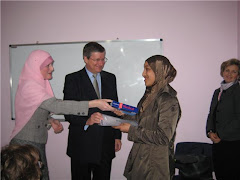
Firstly, I would like to say how proud I am of the Medical English graduates.
They have shown true dedication and commitment to the 6 month programme and I have been impressed and inspired by their determination, especially during the past few weeks when they have almost lived at the school in order to achieve the grades they require!!
Some have progressed beyond my wildest imagination through their hard work and perseverance whilst others have provided a constantly high level of performance throughout providing support for their colleagues.

They have been an absolute pleasure to teach and I hope that insha’Allah we will remain in touch in the future so that they can continue to develop their English skills to enable them to achieve their full potential and because I have developed good relationships with many of them and feel like my children are leaving home!!!!
Each and every one of you more than deserves this certificate and I congratulate you all on a job very well done!

As most of you know, I shall be leaving Algeria for a number of months to practice clinically and undergo some training in the UK in order to ensure that Medical English at Hopeland remains the most up-to-date and relevant programme of its kind in Algeria. It is hoped that during this time I can also develop the Advanced Medical English, English for Research and English for Pharmacists Programmes as well as Medical Sejour Linguistique.
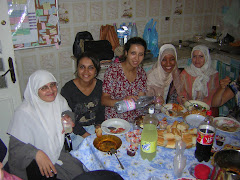
Insha’Allah I will be back at the end of the year but would like to wish you all in the interim much success in your continued studies and look forward to hearing from you whilst in the UK!

It's not all work, work, work!!!!!!

It's not all work, work, work!!!!!!